
Written by Saurabh Kelkar
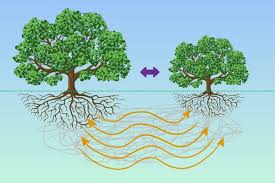
Beneath the quiet stillness of a forest lies a hidden world of connection. Trees are not solitary beings competing for sunlight; they are part of a vast, interconnected network. Through underground fungi and airborne chemical signals, they share nutrients, warn each other of danger, and support weaker neighbors. This system is called the “Wood Wide Web.” (Popkin, G., 2019)
But as climate change intensifies, this ancient communication network could be under threat, with trees losing their ability to “talk” as they dwindle.
The Secret Language of Trees
Trees communicate in two primary ways: underground and above ground.
Below the surface, roots are linked by mycorrhizal fungi—microscopic threads that connect multiple trees. Through these networks, trees can transfer nutrients like carbon and nitrogen. Older “mother trees” have even been observed to support younger saplings by supplying them with resources (Simard et al., 1997).
Above ground, trees release chemical signals into the air. When attacked by pests, some species emit compounds that warn neighboring trees, prompting them to produce defensive chemicals (Heil & Karban, 2010).
This communication is not conscious or intentional in a human sense, but it is highly sophisticated and essential for forest survival.
Climate Change: A Disruptive Force
Climate change is altering the conditions that make these communication systems possible.
- Drought Stress
Prolonged drought weakens trees and limits their ability to produce and share resources. It also damages fungal networks in the soil, reducing connectivity between trees (Allen et al., 2010). - Rising Temperatures
Heat stress forces trees to prioritize survival over communication. With less energy available, processes like chemical signaling and nutrient exchange could decline. - Wildfires and Extreme Events
More frequent and intense wildfires (natural and manmade) destroy both trees and the underground fungal networks that connect them. Once these systems are broken, they can take decades to recover. (IPCC, 2021)) - Soil Degradation
Climate change accelerates soil erosion and reduces moisture levels, harming fungi that depend on stable, nutrient-rich environments. Without fungi, the “Wood Wide Web” collapses.
Why Tree Communication Matters
When communication breaks down, forests become more vulnerable.
With the loss of their “early warning systems”, trees may no longer alert each other to pests or disease; weak or young trees receive less support; forests struggle to recover from stress and disturbances. In essence, climate change doesn’t just remove individual trees—it disrupts the relationships that keep forests functioning as a whole.
A Silent Forest?
Forests have always adapted to change, but the speed of modern climate change is unprecedented. As temperatures rise and ecosystems shift, the intricate networks beneath our feet are being strained in ways we are only beginning to understand.
If these communication systems continue to degrade, forests could become quieter, not just in sound, but in connection. And a disconnected forest is a fragile one.
References
- Popkin, G. (2019). ‘Wood Wide Web’—The Underground Network of Microbes That Connects Trees—Mapped For First Time. Science, 15.
- Allen, C. D., Macalady, A. K., Chenchouni, H., Bachelet, D., McDowell, N., Vennetier, M., … & Cobb, N. (2010). A global overview of drought and heat-induced tree mortality reveals emerging climate change risks for forests. Forest ecology and management, 259(4), 660-684.
- Heil, M., & Karban, R. (2010). Explaining evolution of plant communication by airborne signals. Trends in ecology & evolution, 25(3), 137-144.
- Simard, S. W., Perry, D. A., Jones, M. D., Myrold, D. D., Durall, D. M., & Molina, R. (1997). Net transfer of carbon between ectomycorrhizal tree species in the field. Nature, 388(6642), 579-582.
- IPCC (2021). Climate Change 2021: The Physical Science Basis.